

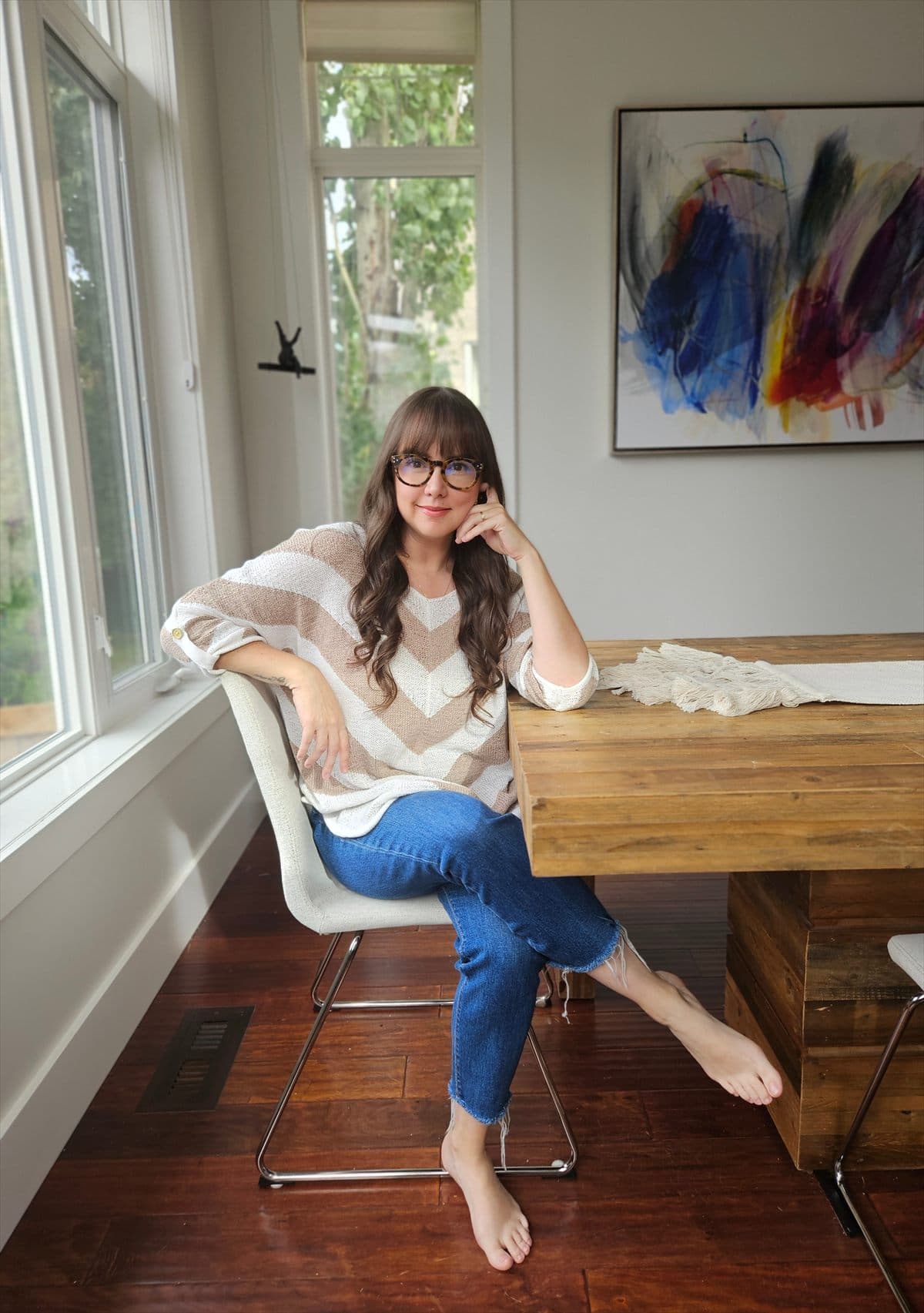
Hi, I’m Vero.
Veronica Pertuso
Bilingual Birth Worker & Educator
For as long as I can remember, I've been curious about people — how we think, how we feel, how we make sense of what happens to us, and what helps us find our way through experiences that change us.
That curiosity first led me to psychology. Years later, it led me into birth rooms. And over time, it has continued to shape the work I do across fertility, pregnancy, birth and postpartum.
BREATHE is where all of those parts of my work — and of me — have found a place to come together.

How I Got Here
Long before birth work became my profession, I was fascinated by the world of pregnancy, birth and motherhood.
I was the person who wanted to hear the birth stories. I asked my mom to tell me about her births — especially mine — over and over again. I wanted to know what happened, what it felt like, what people remembered. I didn't have a name for that curiosity yet. I just knew I wanted to understand.
At the same time, I was deeply curious about people — our stories, relationships, emotions, and the ways our experiences shape us. That curiosity led me to spend six years studying Clinical Psychology in Venezuela, where I earned my degree.
But the pull toward the perinatal world never really went away.
Years later, a friend said something that would quietly change the direction of my work:
“I think you would be an excellent doula.”
My response was essentially: What's a doula?
So I looked it up.
And as I learned what the work actually was, something clicked. This was the work I had been trying to find.
In 2018, I began my journey as a birth worker. What started with birth support grew into years of working alongside families through pregnancy, birth and postpartum. Since then, I've had the privilege of supporting more than 150 families through my work as a full-spectrum doula.
Looking back, the different parts of my professional story don't feel nearly as separate as they once did.
Psychology wasn't something I added to birth work. It was part of the foundation I brought into it.
And Then, Some of It Became Personal
For years, I learned through study, training, birth rooms, postpartum homes, and the families who trusted me enough to let me into some of the most intimate moments of their lives.
Then, when it was time to grow my own family, some of the things I had spent years learning about became part of my own story.
I had trained in fertility support before experiencing infertility myself. I understood the terminology. I knew how to research. I knew how to ask questions.
And then I was the person sitting in the chair at the doctor's office, waiting for someone to explain my own test results.
I still remember that appointment. The doctor began explaining what my results could mean and moved almost immediately into conversations about IVF and egg donation. I understood the words she was saying. And at some point, I stopped hearing them.
I was completely overwhelmed.
That moment taught me something I don't think I could have fully understood from training alone: understanding the language doesn't necessarily mean you have the capacity to process the information when the life being discussed is your own.
Over the course of three years, six fertility treatments, and two pregnancy losses, that lesson would take on many different forms. The information wasn't just information anymore. It was about my life, my future, my family, and decisions that felt much harder when I was the one making them.
Pregnancy, pregnancy after loss, birth and postpartum would continue to deepen that understanding in different ways.
Those experiences didn't make me an expert in someone else's story. They changed the way I listen to it.
They taught me that knowing something professionally and living inside its uncertainty are two very different things. That sometimes people need information, and sometimes they need help making sense of the information they already have. That being supported can matter even when there isn't a problem to solve.
And they made me want to keep learning.
I learned because I was curious.
I learned because I needed to.
And now I know how to turn that knowledge into support.
The Learning Has Never Stopped
One of the things I learned very quickly in this work is how much there is to know — and how much there will always be left to learn.
Since entering the birth world, I've continued to study across birth, postpartum, fertility, breastfeeding, childbirth education, pregnancy and infant loss, emotional support, wellness, and holistic care.
Some of that learning has happened through formal training and certifications. Some through research. Some through the professionals I've had the privilege of learning alongside. And an enormous amount through the families who have allowed me to accompany them.
Along the way, my professional education has included training and certifications through organizations such as DONA International, Bebo Mia, Spinning Babies, Birthing From Within, the Dr. Sears Wellness Institute, and the Health Coach Institute, as well as the training and certification process to become a Perinatal Reiki Practitioner. I've also continued learning through additional education in areas including breastfeeding, fertility support, pregnancy and infant loss, and mental health and crisis-related support.
Learning has always been part of who I am — not only as a professional, but as a person.
The work I do lives within some of the most complex and transformative experiences of human life. There will always be more to understand, new questions to ask, and perspectives that challenge what we thought we knew.
That's why staying curious, informed, and willing to change my understanding when I learn something new is part of the commitment I make to myself and to the people who trust me with their stories.
Knowledge is powerful. And knowledge is never finished.
How I Work
Your story comes before my answer.
Every person arrives with a different history, different questions, different fears, different hopes, and a different way of moving through what they're experiencing. I don't believe support should look exactly the same for everyone.
So I listen first.
I ask questions. I pay attention. I try to understand not only what you're navigating, but what might actually be helpful to you in that moment.
Sometimes that means information. Sometimes it means breaking something complicated into smaller, more manageable pieces. Sometimes it means exploring options or figuring out what questions you want to ask next. Sometimes it means sitting with an emotion that doesn't need to be fixed.
And sometimes, yes, it means telling you the truth when the truth is what you need — with kindness, but without dancing around it.
I bring knowledge into the room, but I also bring curiosity, intuition, empathy, honesty, and a sense of humor. Because supporting a person well isn't only about knowing things. It's about knowing how to be with someone while they figure out what those things mean for them.
I listen before I offer.
I inform without imposing.
I support without trying to fix.
And through all of it, I try to remain deeply intentional about everything I do.
In English. En Español.
Being bilingual isn't simply a practical part of my work. It's part of who I am.
I was born and raised in Venezuela, and today I support families in both English and Spanish. Sometimes one language feels more natural. Sometimes the words you need come more easily in one than the other. And sometimes, especially in vulnerable or overwhelming moments, the language in which you feel most like yourself matters.
You don't have to choose one here.
English, Español — or somewhere in between.
Where I Am Today
BREATHE has changed as I have.
What began with birth and postpartum support has grown alongside my experience, my education, my own life, and the questions that have continued to pull me deeper into this work.
Today, BREATHE brings those pieces together.
It's a space where I support people through fertility, pregnancy, birth and postpartum — through education, emotional support, practical guidance, energetic care, and the kind of conversations that help make complicated experiences a little easier to understand and hold.
The way I work has evolved over the years, but the reason behind it has remained remarkably simple:
I want people to feel seen, informed, supported, and part of their own experience.